Dhimalish languages
| Dhimalish | |
|---|---|
| Dhimal–Lhokpu–Toto | |
| Geographic distribution | India, Nepal |
| Linguistic classification | Sino-Tibetan
|
| Subdivisions | |
| Language codes | |
| Glottolog | dhim1247 |
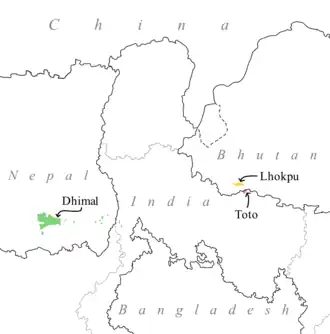 Map of the Dhimalish languages | |
The Dhimalish languages, Dhimal and Toto, are a small group of Sino-Tibetan languages spoken in Nepal, Bhutan, and the Jalpaiguri division of West Bengal, India.
Classification
Hammarström, et al.[1] note in Glottolog that Dhimalish is best considered to be a separate Sino-Tibetan branch rather than as a subgroup of Brahmaputran (Sal), and consider Dhimalish as failing to show sufficient Brahmaputran diagnostic vocabulary. Sotrug (2015)[2] considers Dhimalish to be particularly closely related to the Kiranti languages rather than to the Sal languages.
Grollmann & Gerber (2017)[3] consider Lhokpu to have a particularly close relationship with Dhimal and Toto.
Gerber & Grollmann (2018)[4] group Dhimal, Toto, and Lhokpu within Central-Eastern Kiranti.
Comparative vocabulary
Sanyal (1973:77–81) provides a comparative word list of Toto from Sunder (1895)[5] and George Abraham Grierson's Linguistic Survey of India,[6] and Dhimal from Brian Houghton Hodgson.[7][8]
| English gloss | Toto (Sunder) | Toto (Grierson) | Dhimal (Hodgson) | Page no. |
|---|---|---|---|---|
| air | bingah | – | – | 77 |
| ass | – | pangbu | – | 77 |
| brother | eh | apu; e | yolla | 77 |
| belly | – | pa-ma | hemang | 77 |
| back | – | ju-ma | gandi | 77 |
| brinjal | bengini | – | – | 77 |
| bird | – | bakhi | jiha | 77 |
| behind | – | no | – | 77 |
| blood | viti | – | – | 77 |
| beat | – | sapu | – | 77 |
| before | – | dongangta | – | 77 |
| bullock | pekah-dambe | – | – | 77 |
| cat | minki | minki | dankha-menko | 77 |
| cock | odangpa | keka | dhangai-kai | 77 |
| come quickly | to-to-wa-wang | le-le | dhi-dhi | 77 |
| cow | – | pika | mahani-pia | 77 |
| daughter | memi-cheng | chai-me | chamdi | 77 |
| devil | – | jishang | – | 77 |
| duck | hangsa | hangsa | hangs | 77 |
| die | – | sipuna | sili | 77 |
| dog | kia | kia | khia | 77 |
| down | – | lijuing | – | 77 |
| door | lafoong | – | duar | 77 |
| eat | – | char | chabi | 77 |
| eye | michu | – | mi | 77 |
| eyebrow | mimu | – | – | 77 |
| elephant | hati | – | – | 77 |
| elder sister | anna | – | – | 77 |
| evening | jilong | – | – | 78 |
| ear | nanoong | – | naha-thong | 78 |
| far | – | hinda-mina | – | 78 |
| fire | meh | megue | mau | 78 |
| forehead | ting-ang | – | – | 78 |
| foot | tang-ba | – | kokoi | 78 |
| father | appa | apa | aba | 78 |
| of father | – | apak | – | 78 |
| two fathers | – | apa-nisa | – | 78 |
| fish | ngya | – | – | 78 |
| fever | haina | – | – | 78 |
| good | – | entana | – | 78 |
| give | – | picha | – | 78 |
| girl | chame | – | – | 78 |
| god | – | iswal | – | 78 |
| go north | enta-vatu | – | – | 78 |
| go east | nuta-vatu | – | – | 78 |
| go south | leta-vatu | – | – | 78 |
| go west | dita-vatu | – | – | 78 |
| go | vatu; hatu | chhapur | hadeli | 78 |
| hair | puring | puring | poshom | 78 |
| he | – | – | wa | 78 |
| he-goat | edang | – | – | 78 |
| horse | onyah | aia | – | 78 |
| high | – | hinda-nina | – | 78 |
| hand | kooe | kui | khur | 78 |
| his | uko | – | oko, wang | 78 |
| head | pudung | pudang | purin | 78 |
| house | – | sa | sa | 78 |
| I | kug-ve | kate | ka | 78 |
| iron | – | chaka | chir | 78 |
| jackfruit | dangse | – | – | 79 |
| jungle bamboo | – | – | – | 79 |
| lips | megoe | – | – | 79 |
| leg | kok-koi | – | khokoi | 79 |
| lime | churai | – | – | 79 |
| man | – | deya | waved | 79 |
| mother | aeu | aio | amma | 79 |
| mouth | noohgung | – | – | 79 |
| monkey | nokka | – | – | 79 |
| milk | yoti | – | – | 79 |
| moon | tari | tari | tali | 79 |
| morning | habkong | – | – | 79 |
| nose | nabboh | – | – | 79 |
| nails | kushing | – | – | 79 |
| near | – | abeto | – | 79 |
| night | lishong | – | – | 79 |
| no | – | ma-koe | – | 79 |
| orange | santra | – | – | 79 |
| our | kongo | – | king | 79 |
| pig | pakka | – | – | 79 |
| pan leaf | parai | – | – | 79 |
| plantain | eungpi | – | – | 79 |
| plantain tree | eungpi | – | – | 79 |
| paddy | mabe | – | – | 79 |
| river | tihana | – | – | 79 |
| rain | vathi | – | – | 79 |
| rice | unku | – | – | 79 |
| rice-beer | eu | – | – | 79 |
| run | – | tui | – | 79 |
| rupee | tanka | – | – | 79 |
| sister | – | ing | rima | 79 |
| sun | sani | chhani | bela | 79 |
| son | chung | chao, chaoa | chau | 79 |
| stand | – | lo-lo | – | 79 |
| star | puima | – | – | 79 |
| salt | ngi | – | – | 80 |
| sit | – | iyung | yongli | 80 |
| tiger | koogah | – | – | 80 |
| thigh | vybe | – | – | 80 |
| thou | – | na-ga | – | 80 |
| tree | singe | – | – | 80 |
| tooth | shitang | – | sitong | 80 |
| tongue | lebek | – | detong | 80 |
| up | – | jujuntaye | – | 80 |
| water | ti | ti | chi | 80 |
| we | – | na-te | kyel | 80 |
| woman | – | mem-bi | beval | 80 |
| wife | – | me | be | 80 |
| who | – | ha | jeti-siti | 80 |
| why | – | ha-ranga | haipali | 80 |
| younger sister | ing | – | – | 80 |
| yes | – | ke | he | 80 |
| you | naga | – | nye | 80 |
| 1 | eoo | che | e-long | 80 |
| 2 | nih-hu | ne | gne-long | 80 |
| 3 | soongu | sung | sum-long | 80 |
| 4 | diu | ji | dia-long | 80 |
| 5 | ngyu | nga | na-long | 80 |
| 6 | tuu | tu | tu-long | 80 |
| 7 | niu | dun | nhu-long | 80 |
| 8 | yau | ge, ne | ye-long | 80 |
| 9 | kuu | gu | kuha-long | 80 |
| 10 | thau | chu-tamba | te-long | 80 |
| 20 | chuniso | nisa | e-long-bisha | 81 |
| 100 | nakai | nga-kai | na-long-bisha | 81 |
See also
- Dhimalish comparative vocabulary list (Wiktionary)
References
- ^ "Glottolog 4.4 – Kenaboi".
- ^ Sotrug, Yeshy T. (2015). Linguistic evidence for madeskā kirãntī. The phylogenetic position of Dhimalish. Bern: University of Bern Master’s Thesis, 22 June 2015.
- ^ Grollmann, Selin and Pascal Gerber. 2017. Linguistic evidence for a closer relationship between Lhokpu and Dhimal: Including some remarks on the Dhimalish subgroup. Bern: University of Bern.
- ^ Pascal Gerber; Selin Grollmann (2018). What is Kiranti? A Critical Account. Bulletin of Chinese Linguistics 11 (2018) 99–152.
- ^ Sunder, D. H. E. 1895. Survey and Settlement of Western Duars in the District of Jalpaiguri, 1889–1895.
- ^ Grierson, George A. 1909. Linguistic Survey of India (Vol. III, Part I, Tibeto-Burman Family: Tibetan Dialects, the Himalayan Dialects and the North Assam Group). Calcutta: Superintendent of Government Printing, India.
- ^ Hodgson, Brian. 1874. Essays on the Languages, Literatures, and Religion of Nepal and Tibet. London: Truebner and Co.
- ^ Hodgson, Brian Houghton. 1880. Miscellaneous Essays relating to Indian Subjects (2 vols.). London: Trübner & Co.
- George van Driem (2001) Languages of the Himalayas: An Ethnolinguistic Handbook of the Greater Himalayan Region. Archived 2011-06-28 at the Wayback Machine Brill: Boston
- Sanyal, Charu Chandra. 1973. "The Totos: A sub-Himalayan tribe." In The Meches and the Totos, 1–81. Darjeeling: University of North Bengal.
Sino-Tibetan branches | |||||
|---|---|---|---|---|---|
| Western Himalayas (Himachal, Uttarakhand, Nepal, Sikkim) |
|  | |||
| Eastern Himalayas (Tibet, Bhutan, Arunachal) | |||||
| Myanmar and Indo- Burmese border |
| ||||
| East and Southeast Asia |
| ||||
| Dubious (possible isolates, Arunachal) |
| ||||
| Proposed groupings | |||||
| Proto-languages | |||||
Italics indicates single languages that are also considered to be separate branches. | |||||